Article: What is the best home racing simulator?
What is the best home racing simulator?
A home racing simulator is not just a gaming setup anymore. For many racing fans, it becomes a small personal track at home. You sit down, hold the wheel, press the pedals, and suddenly a normal evening feels a lot more exciting. The best setup is the one that fits your room, your budget, and the type of racing you actually enjoy.
You might like: Best Home Golf Simulators for Sale Online
Start With Your Racing Goals
Before buying a home racing simulator, be honest about how you plan to use it. Some people want weekend fun. Some want to practice serious lap times. Some just want a better feeling than a controller can give.
Order Now to Secure Yours!

If you are new to sim racing, you do not need the biggest cockpit or the most expensive wheel. A simple wheel and pedal combo can already make racing feel completely different. You get better steering control, smoother cornering, and a stronger sense of what the car is doing.
A basic driving simulator setup can start with a wheel clamped to a desk and pedals placed underneath. It may not look like a professional rig, but it works. Later, when you know you love the hobby, you can add a wheel stand, a racing seat, or a stronger pedal set.
Spoiler alert: expensive gear does not always mean better racing. A stable, comfortable setup usually feels better than a costly one that shakes, slides, or takes too much space.
The real goal is simple. You want a setup that makes you want to race again tomorrow.
What Should a Good Setup Include?
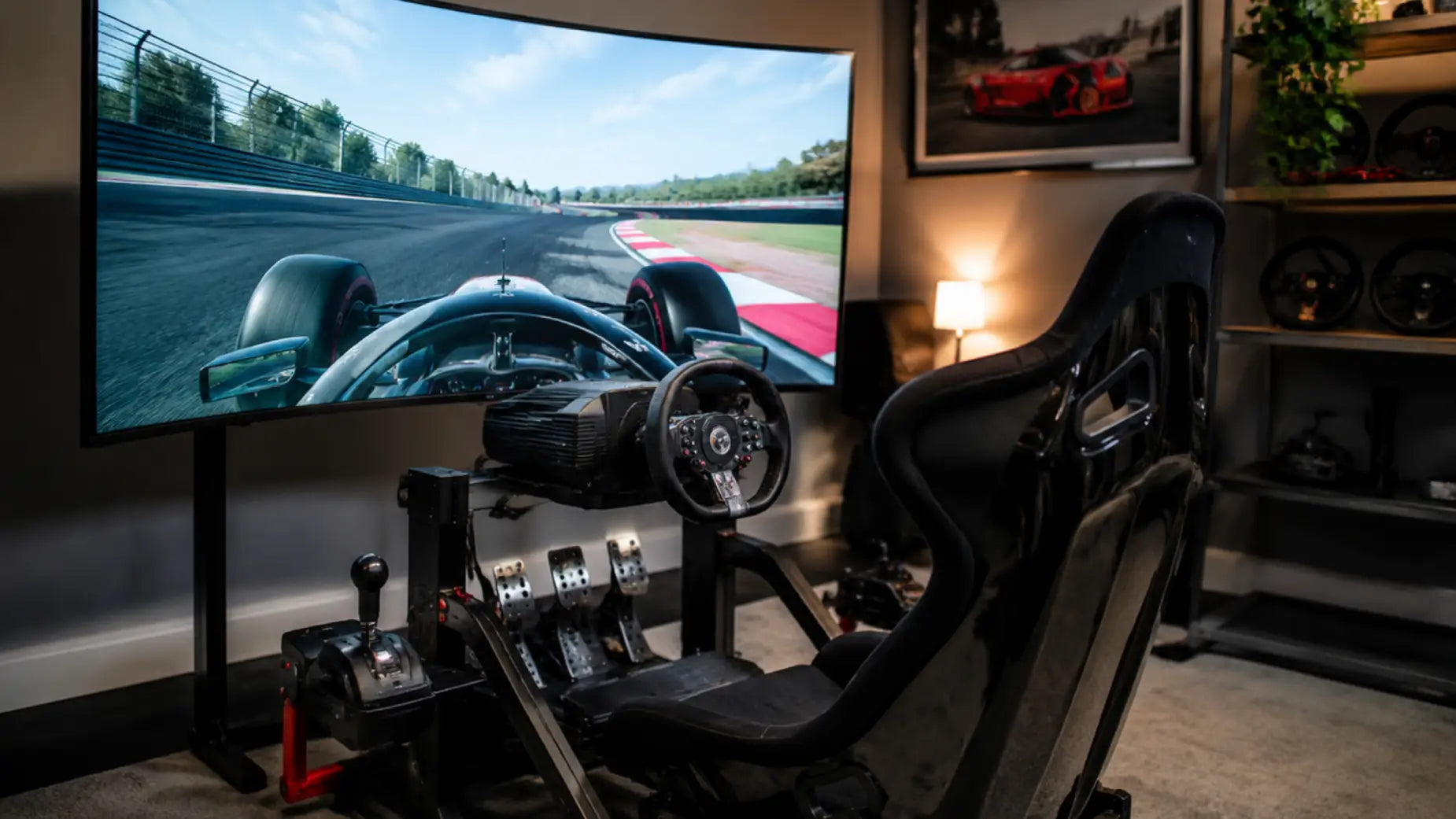
A good home racing simulator usually has a few main parts: a racing wheel, pedals, a stand or cockpit, a screen, and racing software. These pieces work together to create the full driving experience.
The wheel is the first thing most people notice. A force feedback wheel lets you feel steering weight, bumps, curbs, and grip changes. This is what makes a race car simulator feel more connected than a normal racing game.
Pedals are just as important. In fact, many experienced sim racers care more about pedals than the wheel. Good pedals help you brake smoothly and repeat the same braking pressure lap after lap. If your pedals slide across the floor every time you brake, your racing will feel messy fast.
A stand or cockpit keeps everything steady. Even a basic stand can improve your racing sim set up because the wheel stays fixed and the pedals stay in place.
Home Racing Simulator Checklist
|
Part |
Why It Matters |
|
Racing Wheel |
Gives steering feel and force feedback |
|
Pedals |
Helps with braking and throttle control |
|
Wheel Stand or Cockpit |
Keeps the setup stable |
|
Seat Position |
Makes longer races more comfortable |
|
Monitor or TV |
Helps with visibility and immersion |
|
Racing Game |
Controls physics, cars, and tracks |
You can keep things simple at first. Buy the main parts, race for a while, then upgrade what actually needs improvement.
Beginner Racing Simulator Set Up
A beginner racing simulator set up should be easy to use. You should be able to sit down, plug in, and start racing without spending half your time adjusting settings.
For most beginners, a force feedback wheel and pedal set is enough. You can mount the wheel to a desk or use a foldable stand. This type of home racing simulator is great if you have limited space or if you are not ready for a full cockpit.
The big benefit is control. With a wheel, you can steer more smoothly. With pedals, you can accelerate and brake with better timing. Even if your lap times are not perfect at first, the experience feels more natural.
Do not worry too much about having the “perfect” gear. You will learn what you like after using it for a few weeks. Maybe you will want better pedals. Maybe you will want a stronger stand. Maybe you will decide one screen is enough. That is normal.
A simple setup is not a bad setup. It is often the smartest way to begin.
Hot Deals!

Advanced and Realistic Racing Simulator Options
Once you get deeper into sim racing, you may start looking at a more realistic racing simulator. This is where the hobby can become very serious.
Advanced setups often include direct-drive wheels, load-cell pedals, aluminum cockpits, shifters, handbrakes, triple monitors, VR headsets, and even motion systems. These upgrades can make racing feel much closer to real driving.
A direct-drive wheel gives stronger and more detailed feedback. Load-cell pedals make braking feel more consistent because they respond to pressure, not just movement. A rigid cockpit stops the wheel and pedals from moving around. Together, these upgrades can make your racing sim set up feel much sharper.
But here is the honest part: not everyone needs all of this. Guess what? A mid-range setup is usually the sweet spot for most home users. It gives you better control, better comfort, and better realism without becoming too expensive or too complicated.
If you race often, upgrade the parts you touch most. Start with pedals, then the wheelbase, then the cockpit. Those three areas usually make the biggest difference.
Best Racing Sims to Play at Home
The hardware matters, but the software matters too. The best racing sims can make a basic setup feel exciting, while poor software can make even expensive gear feel boring.
Look for racing games that match your style. If you enjoy clean track racing, choose a sim with realistic circuits and strong physics. If you like road cars, choose something with a wide car selection. If you want serious competition, look for active online racing.
A good simulator game teaches patience. Brake too late, and you miss the corner. Turn too sharply, and the tires complain. Hit the throttle too early, and the car slides. It can be frustrating at first, but that is also what makes it rewarding.
Your screen setup also changes the feel. A single monitor or TV is fine for most players. Triple screens can improve side vision, and VR can make the cockpit feel more real. Still, both options need more space, more setup time, and sometimes a stronger PC.
The best choice is not always the most advanced one. Choose a racing game you enjoy enough to play again and again.
Buy Today & Save

How Much Is a Racing Simulator?
A common question is, how much is a racing simulator? The answer depends on how far you want to go.
A budget home racing simulator may include an entry-level wheel and pedals. This is good for casual players who want better control without spending too much. You can use a desk, a normal chair, and a simple screen.
A mid-range setup usually includes a better wheel, stronger pedals, and a proper wheel stand or cockpit. This level feels more polished. The wheel does not shake as much, the pedals stay put, and your seating position feels more like a real car.
A premium setup can cost much more. It may include a direct-drive wheel, load-cell or hydraulic pedals, a strong cockpit, triple screens, VR, shifter, handbrake, and motion feedback. This kind of race car simulator is for people who want serious realism.
Here is a simple way to think about it:
- Budget setup: Best for beginners and casual racing
- Mid-range setup: Best for regular home racing
- Premium setup: Best for serious sim racing fans
The smartest plan is to build slowly. Start with wheel and pedals. Add a stand or cockpit later. Improve your driving simulator setup only when you know what is missing.
How to Choose the Best Car Simulator for Your Space
The best car simulator is not only about performance. It also has to fit your home.
Before buying a full cockpit, measure your room. A large racing rig may look amazing online, but it can become annoying if it blocks your desk, bed, or walking space. If you have a small room, a foldable stand may be a better choice.
Think about where you will sit. A normal office chair can roll backward when you brake, which gets frustrating quickly. Some people fix this with wheel stoppers or a mat. Others move to a proper racing seat.
Also check platform compatibility. Some wheels work on PC only. Some support PlayStation. Some support Xbox. Make sure your wheel, pedals, and game all work together before buying.
Noise is another small detail people forget. Strong wheels, metal pedals, and shifters can be louder than expected. If you live with family or race late at night, choose your racing simulator set up carefully.
A good home racing simulator should make your space better, not more stressful.
You may want to check out: Best Flight Simulators for Home & Professional Use
Final Verdict: What Is the Best Home Racing Simulator?
The best home racing simulator is the one that feels comfortable, stable, and fun for your style of racing. It does not need to be the most expensive setup in the room. It just needs to work well for you.
For beginners, a force feedback wheel and pedals are the right place to start. For regular racers, a proper stand or cockpit is worth adding. For serious drivers, better pedals and a stronger wheelbase can make a big difference.
Do not rush the process. Start with a setup you can actually use often. Race with it. Notice what feels weak. Then upgrade one part at a time.
A well-planned home racing simulator can give you better control, more excitement, and a much more realistic way to enjoy racing from home.
Ready to build your own racing space? Explore our home racing simulator collection and find the right setup for your next race night.
People Also Ask:
Is 16GB RAM enough for sim racing?
16GB RAM is totally fine for sim racing if you plan on using a single screen with normal graphics and settings. There are tons of racing simulators that can run perfectly fine with 16GB RAM, assuming you have a decent CPU and GPU. 16GB of RAM is a solid choice, but if you’re going to be using a triple monitor setup, VR, mods, streaming, and running complex graphics, you should probably go for 32GB of RAM.
How much do I need to spend on a PC for sim racing?
Most decent trading sim computers run between $800 and $1,200, but that’s only for a basic entry-to-mid-level trading simulator that can run the majority of racing sims on a single screen. For better performance with more intensive graphics that can run on an ultrawide monitor, expect to spend $1,500-$2,000 on a simulator. Anything that can run in VR, with three monitors, at max settings with high competitive performance will run you over $2,000.